
How to Choose the Best Marine Batteries?
Choosing Marine Batteries is not just a matter of matching voltage. A battery must start the engine, support onboard equipment, and withstand vibration, moisture, and long periods without charging. The wrong choice can mean dim cabin lights or a silent engine at the dock. Small details matter.
Battery technology is changing quickly. BloombergNEF’s 2023 Battery Price Survey reported an average lithium-ion pack price of $139 per kilowatt-hour, a 14% decrease from 2022. That figure covers battery packs across industries, not marine batteries specifically, so it should not be treated as a direct boat-price guide. Still, it shows why comparing upfront cost alone can give an incomplete picture. Chemistry, usable capacity, charging compatibility, and expected service life all affect value.
Start with the boat’s actual electrical demands. Note the engine’s starting requirements, daily loads, charging sources, and available installation space. Then compare flooded lead-acid, AGM, and lithium options against those needs. Check manufacturer specifications, warranty terms, and guidance from a qualified marine technician; installation conditions can change what works safely. There is no universal best battery. Even careful estimates can miss a real-world load, so leave a sensible margin and review the setup after use.
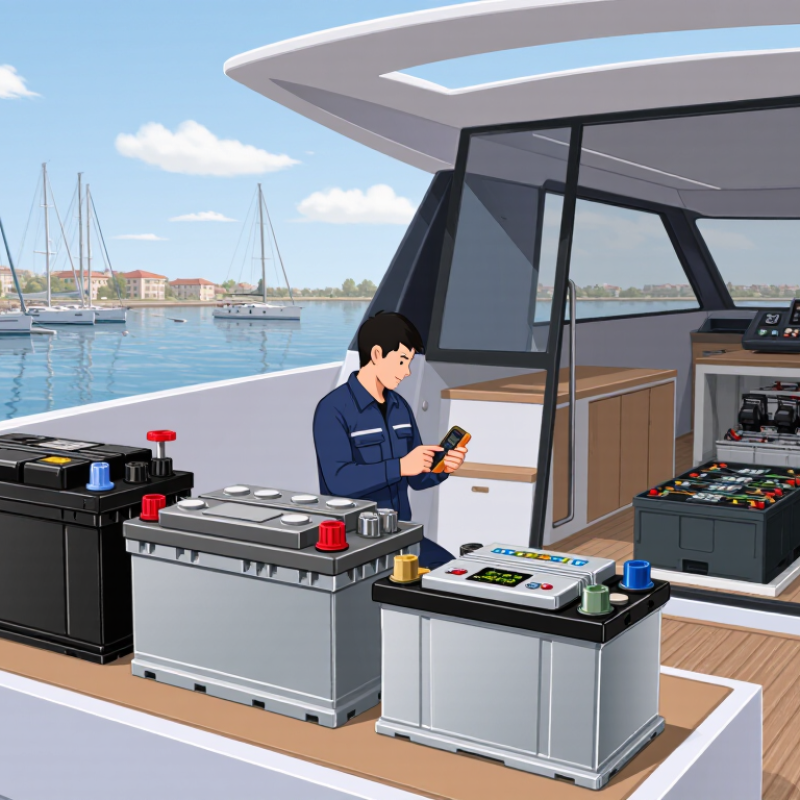
Understanding Marine Battery Types and Their Applications
How to Choose the Best Marine Batteries?
Understanding battery types starts with the boat’s actual workload. Flooded lead-acid batteries remain practical for starting engines and basic onboard systems. They cost less, but need ventilation, inspection, and occasional water replacement. Absorbed glass mat (AGM) batteries resist vibration and accept faster charging. They suit boats with electronics, pumps, and frequent anchoring. Gel batteries offer stable deep-cycle performance, although their charging limits require careful configuration.
Lithium iron phosphate batteries provide lower weight, usable capacity, and rapid recharge times. They can fit electric propulsion, trolling motors, and high-demand cruising systems. DNV’s Maritime Forecast to 2050 identifies battery-electric propulsion as especially suitable for shorter marine routes. However, lithium systems need a compatible charger, battery-management system, and protected installation. The wrong charging profile can shorten service life or create serious heat risks.
Capacity matters more than a large label. A 100 Ah battery does not deliver the same practical energy across every chemistry. The Battery Council International reports that more than 99% of lead batteries are recycled in the United States, supporting their established lifecycle infrastructure. Still, recycling access for lithium marine packs varies by location. A neat spreadsheet can mislead. Review starting current, daily amp-hour demand, reserve time, temperature, and charging equipment together. Leave room for imperfect weather and forgotten loads.
How to Choose the Best Marine Batteries? — Understanding Marine Battery Types and Their Applications
| Battery Type | Typical Nominal Voltage | Recommended Usable Capacity | Typical Cycle Life | Charging Considerations | Best-Suited Marine Applications | Key Advantages and Limitations |
|---|---|---|---|---|---|---|
| Flooded lead-acid | 6 V or 12 V batteries; commonly combined for 12 V, 24 V, or 36 V systems | About 50% of rated capacity for routine use | Roughly 200–500 cycles at about 50% depth of discharge | Use a lead-acid charging profile and provide adequate ventilation. Check electrolyte levels where the design allows; avoid overcharging and prolonged undercharging. | Starting engines and general house loads on boats where low purchase cost and regular maintenance are acceptable | Usually the lowest upfront cost and widely available. Heavy for its capacity, requires maintenance in serviceable designs, and can be damaged by repeated deep discharge. |
| AGM (absorbed glass mat) lead-acid | Typically 12 V per battery; multiple batteries can form higher-voltage banks | About 50% of rated capacity for good service life | Often around 300–700 cycles at about 50% depth of discharge | Use an AGM-compatible charging profile. Follow the battery maker’s voltage limits; do not equalize unless specifically permitted. | Starting, house, or dual-purpose service where a sealed, spill-resistant battery and relatively high output are useful | Sealed and low-maintenance, with good starting performance. Generally heavier and offers less usable capacity per rated amp-hour than lithium; sensitive to incorrect charging. |
| Gel lead-acid | Typically 12 V per battery; banks can be configured for higher system voltages | About 50% of rated capacity for routine use | Approximately 300–700 cycles at about 50% depth of discharge, depending on design and use | Requires a gel-compatible, carefully regulated charging profile. Excessive charging voltage can permanently damage the battery. | House loads and auxiliary equipment where a sealed battery and steady, moderate-rate discharge are priorities | Sealed and maintenance-free, with good resistance to vibration. Usually less suited to high-current charging or rapid charging than some alternatives. |
| Lithium iron phosphate (LiFePO4) | Typically 12.8 V per battery; also available in higher-voltage configurations | Commonly about 80–90% of rated capacity in appropriately designed systems; follow the battery’s limits | Often about 2,000–5,000 cycles under specified conditions; actual life varies with temperature, charge rate, and depth of discharge | Use a charger and alternator setup approved for LiFePO4. The battery management system should protect against overcharge, over-discharge, and low-temperature charging. | House banks, trolling motors, and other frequent or deep-cycle loads where lower weight and greater usable capacity are valuable | High usable capacity, low weight, and fast charging capability. Higher upfront cost; requires compatible charging equipment and appropriate battery management. |
Selection note: Cycle-life and usable-capacity figures are typical estimates, not guarantees. Actual performance depends on the specific battery, temperature, discharge rate, charging practices, and maintenance. Choose a battery rated for the intended starting or deep-cycle duty, and verify compatibility with the boat’s charger, alternator, and electrical system.


